
⏱️ Reading time: 8 minutes
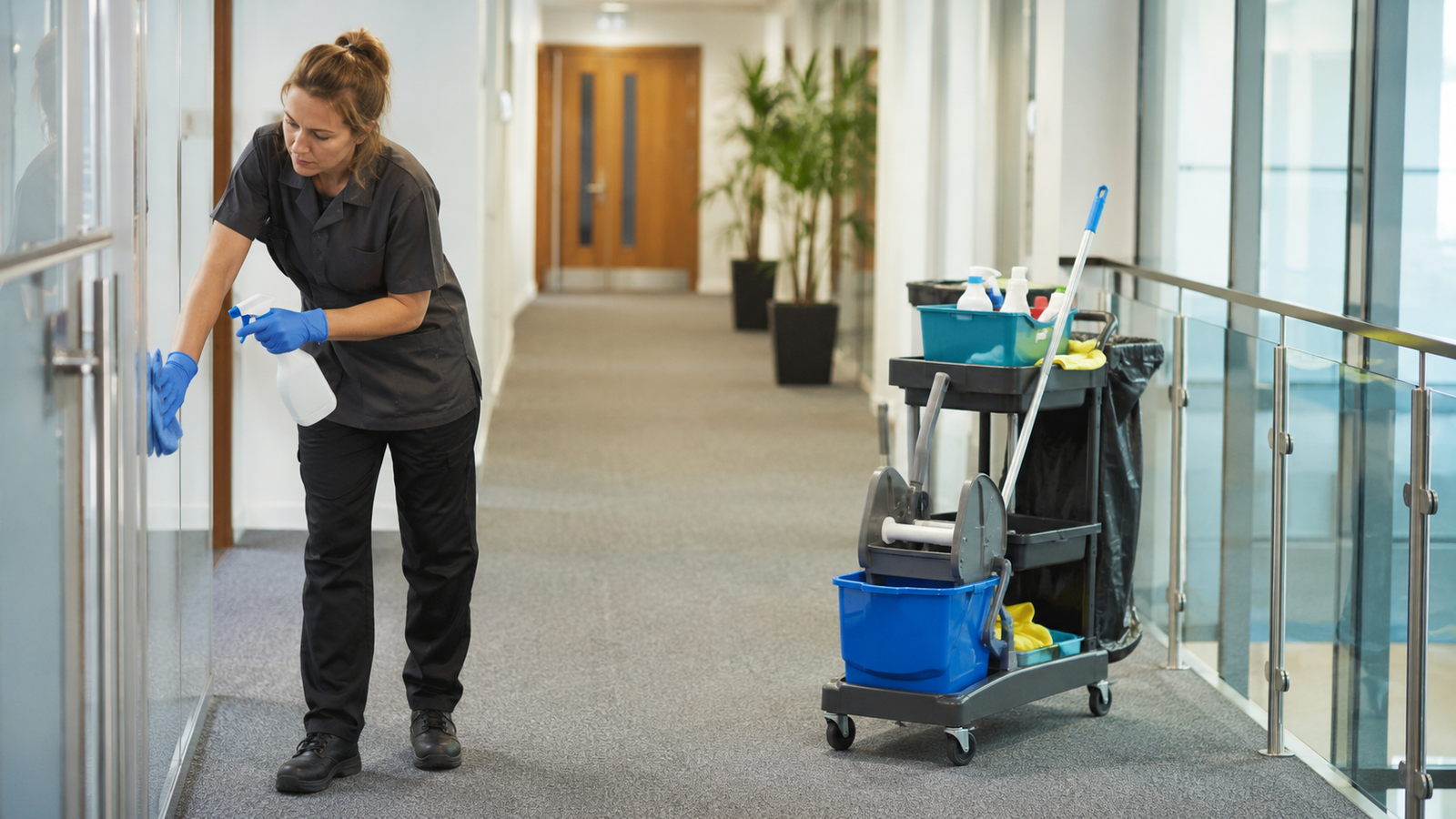
Working as a cleaner in the UK is an important job that requires clear communication — whether you’re cleaning offices, hospitals, or private homes. This guide on English for cleaning jobs in the UK covers the most important phrases for everyday tasks, reporting problems safely, and asking for help or supplies when you need them.
📋 Quick Summary
- Learn essential vocabulary for cleaning supplies and tasks.
- Know how to safely report hazards and broken equipment.
- Ask for help or clarification whenever you need it.
🤖 AI Quick Answer
What English phrases do cleaners need in the UK?
Key phrases include “I need more cleaning supplies, please” for requesting materials, “Caution, the floor is wet” for safety warnings, and “I have finished cleaning the kitchen” for reporting progress. Reporting hazards and broken equipment quickly matters more than perfect grammar.
📖 Key Vocabulary
| Word/Phrase | Meaning |
|---|---|
| Hazard | Something that could cause harm or an accident |
| Skip | A large outdoor container for waste or rubbish |
| Spill | Liquid that has accidentally fallen onto a surface or floor |
| Bleach | A strong cleaning chemical used to disinfect surfaces |
| Warning sign | A sign placed to alert people to a hazard, like a wet floor |
💬 Useful Phrases
“I need more cleaning supplies, please.” 🔊
When/Why to use: Use this when you run out of chemicals, cloths, or bin bags.
Real workplace example: “I’ve run out of bleach. I need more cleaning supplies, please.”
Plain-English explanation: A polite way to ask for more materials to do your job.
“Excuse me, I need to clean this area.” 🔊
When/Why to use: Use this when office staff or customers are in the way of your cleaning.
Real workplace example: “Excuse me, I need to clean this area. Could I quickly vacuum under your desk?”
Plain-English explanation: A polite way to ask someone to move so you can clean.
“Caution, the floor is wet.” 🔊
When/Why to use: Use this to verbally warn someone walking near where you just mopped.
Real workplace example: “Please be careful walking here. Caution, the floor is wet.”
Plain-English explanation: A safety warning to prevent slipping.
“The vacuum cleaner is broken.” 🔊
When/Why to use: Use this to report faulty equipment to your supervisor.
Real workplace example: “I can’t finish the carpet because the vacuum cleaner is broken.”
Plain-English explanation: Explains why a task can’t be done and reports a fault.
“Where should I put the rubbish?” 🔊
When/Why to use: Use this when you don’t know where the external bins or skips are.
Real workplace example: “I’ve emptied the office bins. Where should I put the rubbish?”
Plain-English explanation: Asks for directions to the correct waste disposal area.
“I have finished cleaning the kitchen.” 🔊
When/Why to use: Use this to report that you’ve completed a specific task.
Real workplace example: “Just to let you know, I have finished cleaning the kitchen.”
Plain-English explanation: Updates your supervisor on your progress.
“Could you show me how to use this chemical?” 🔊
When/Why to use: Use this if you’re unsure about safety instructions on a new cleaning product.
Real workplace example: “I haven’t used this spray before. Could you show me how to use this chemical?”
Plain-English explanation: Asks for training to ensure you work safely.
“There is a spill in the hallway.” 🔊
When/Why to use: Use this to report an unexpected mess that needs attention.
Real workplace example: “There is a spill in the hallway. I will clean it up now and put out a sign.”
Plain-English explanation: Informs others of a hazard you’ve found.
🎬 Real Workplace Scenario
🔊 Play Scenario — Reporting a leak in the bathroom
Situation: You’re cleaning an office bathroom and notice a sink is leaking water onto the floor.
You (after placing a warning sign): Excuse me, there is a problem in the men’s bathroom. The sink is leaking and the floor is wet. I have put up a warning sign.
💡 This is clear and professional — you explain exactly what the problem is, where it is, and show that you took safe action by using the warning sign first.
✅ Checklist: Communicating Well as a Cleaner
- ☑️ Always put up a warning sign before or while mopping
- ☑️ Report broken equipment to your supervisor immediately
- ☑️ Ask politely if you’re unsure how to use a chemical
- ☑️ Greet office staff or customers politely, even briefly
- ☑️ Let your supervisor know when you’ve finished a task
- ☑️ Ask for more supplies before you completely run out
⚠️ Common Mistakes to Avoid
| ❌ Mistake | ✅ Better |
|---|---|
| “Give me mop.” | “Could I have the mop, please?” |
| Not putting up warning signs when floors are wet | “Caution, the floor is wet” plus a visible sign |
| Pretending to understand chemical instructions | “Could you show me how to use this chemical?” |
🇬🇧 UK Workplace Tip
Office staff and customers usually appreciate a brief, polite “Good morning” even while you’re working — it costs nothing and helps build a friendly atmosphere, even during a quick task.
📚 What You’ll Learn in Cleaning English
As you gain more experience, you’ll learn workplace English for many different cleaning situations, including:
- Requesting cleaning supplies
- Reporting hazards and spills
- Reporting broken equipment
- Speaking with office staff and customers
- Health and safety vocabulary
- Chemical safety instructions
- Reporting task progress to supervisors
- Waste disposal procedures
- Working in shared and public spaces
- Asking for training on new equipment
💼 Expert Note
Building workplace confidence takes time. Practise these phrases out loud at home, and don’t be afraid to ask people to repeat themselves if you don’t understand.
❓ Frequently Asked Questions
What if I don’t understand my supervisor?
Politely say: “I’m sorry, could you repeat that please?” or “Could you show me what you mean?”
How do I ask for help politely?
Say: “Excuse me, could you give me a hand with this, please?”
How do I report a safety issue?
Tell your supervisor immediately. Say: “I need to report a safety issue. There is broken glass in the hallway.”
What if I make a mistake at work?
Don’t hide it. Tell your supervisor: “I apologise, I have made a mistake here. How can we fix it?”
🧠 Quick Quiz
Q1: What should you do before mopping a floor?
Q2: What should you do if you’re unsure how to use a cleaning chemical?
Q3: What does “hazard” mean?
Ready to Improve Your Workplace English?
Build your confidence with more free workplace English guides, practical examples, and interactive tools designed for real UK workplaces.
Explore More Guides Use Free Tools🛠️ Free Tools
📚 Related Articles
Workplace Communication
How to Speak Politely at Work in the UK
Workplace Communication
How to Ask for Help at Work in the UK
Workplace Communication
How to Explain a Problem at Work
Workplace Communication
How to Talk to Your Manager in English
Workplace Communication
How to Say You Don’t Understand (Politely)