
🕐 Reading time: 7 minutes
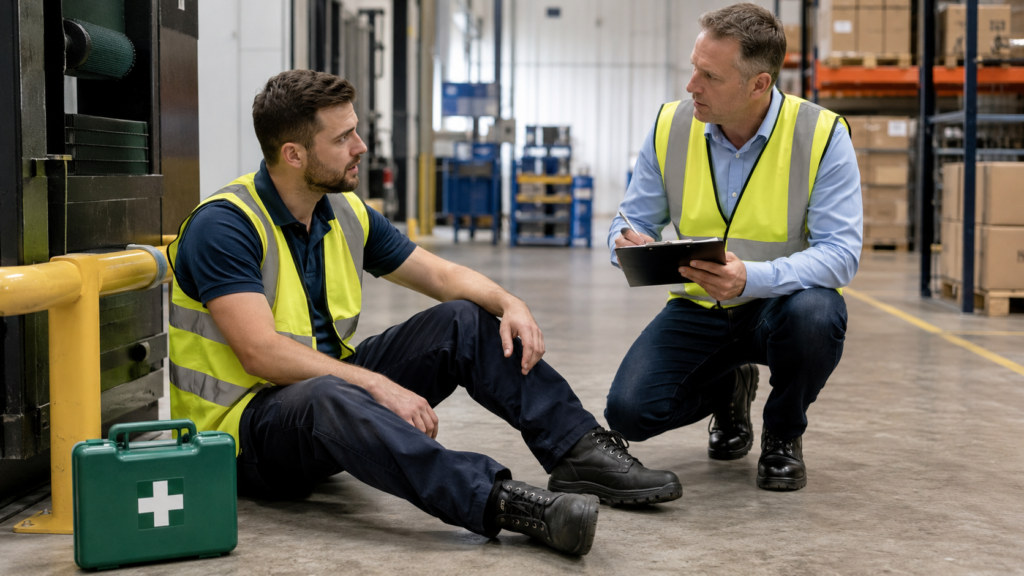
After a workplace accident, it is important to know what to say and what information to give. You may need to speak to your manager, ask for first aid, and help complete an accident report.
This guide teaches simple accident report English for workers in the UK. It focuses on useful words, clear phrases, and real workplace communication.
You do not need perfect English. You only need to explain what happened clearly and calmly.
Quick Summary
- An accident report records what happened at work.
- You should report the accident as soon as possible.
- Use simple facts: when, where, what happened, and how you were hurt.
- Ask for first aid if you need help.
- Check that the information is correct before you sign anything.
AI Quick Answer
How do you complete an accident report in English?
To complete an accident report in English, write the date, time, place, what happened, what you were doing, how you were injured, and who you reported it to. Use clear and simple sentences. For example: “I slipped on a wet floor near the packing area and hurt my back.”
Vocabulary Table
| Word / Phrase | Simple Meaning | Example Sentence |
|---|---|---|
| Accident report | A written record of an accident at work | “We need to complete an accident report.” |
| Incident | Something that happened at work | “Please record this incident.” |
| Injury | Harm to your body | “I have an injury to my hand.” |
| First aider | A trained person who can give basic help | “Can I see the first aider, please?” |
| Witness | A person who saw what happened | “There was a witness near the machine.” |
| Accident book | A workplace record of accidents | “Please record this in the accident book.” |
| Hazard | Something that could cause harm | “The wet floor was a hazard.” |
Useful Phrases
1. “I need to report an accident.”
Situation: You need to tell your manager what happened.
Problem: You are not sure how to start the conversation.
Simple meaning: You are clearly saying that an accident happened and it needs to be reported.
2. “Can I see the first aider, please?”
Situation: You are hurt or feel unwell.
Problem: You need help before paperwork.
Simple meaning: You are asking for basic medical help at work.
3. “It happened at [time] near [place].”
Situation: You need to explain when and where the accident happened.
Problem: The report needs clear details.
Simple meaning: You are giving the time and location.
4. “I was [doing the task] when it happened.”
Situation: You need to explain what you were doing.
Problem: Your manager needs to understand the work activity.
Simple meaning: You are explaining your task before the accident.
5. “I would like a copy of the report for my records.”
Situation: You want to keep a copy of the accident report.
Problem: You need a clear and polite phrase.
Simple meaning: You are asking to keep a copy for yourself.
Real Workplace Scenario
Character: Daniel
Job role: Packing worker
Location: Manchester
Daniel is working near a packaging machine. While moving a box, he cuts his hand on a sharp edge. He feels worried but knows he must report it.
Daniel: Excuse me, I need to report an accident. I cut my hand on the packaging machine.
Manager: Are you alright? Let’s get you to the first aider first.
Daniel: Thank you. After it is cleaned and covered, can we write it in the accident book?
Manager: Yes, of course. We will complete the report together.
Key lesson: Daniel reports the accident clearly, asks for first aid, and makes sure the accident is recorded.
Checklist
- Tell your manager or supervisor as soon as possible.
- Ask for first aid if you are hurt.
- Say the date and time of the accident.
- Say where it happened.
- Explain what you were doing.
- Explain how you were injured.
- Say if anyone saw the accident.
- Check the report before you sign it.
Common Mistakes
❌ Mistake 1: Waiting too long
Better: Report the accident as soon as possible.
❌ Mistake 2: Giving unclear information
Wrong: “Something happened near the machine.”
Better: “I cut my hand on the packaging machine at 10:30.”
❌ Mistake 3: Forgetting the location
Better: Say exactly where it happened, such as “near the loading bay” or “on line 3”.
❌ Mistake 4: Not asking for first aid
Better: Say, “Can I see the first aider, please?”
❌ Mistake 5: Signing without checking
Better: Read the accident report carefully before you sign it.
UK Workplace Tip
Many UK workplaces use an accident book or an electronic accident reporting system. The report should include clear facts about what happened.
Some serious accidents may need extra reporting by the employer. You do not need to know all the legal details, but you should always report the accident to your manager as soon as possible.
Expert Note
This guide is for workplace English and communication. It is not legal or medical advice.
If you are injured, your health comes first. Ask for first aid or medical help before worrying about paperwork.
When completing an accident report, use simple facts. Do not guess. If you are not sure, say: “I am not sure, but I think…”
Quick Quiz — Test Yourself
1. What should you do first if you are injured?
2. Which sentence is clear?
3. What is an accident report?
4. What should you check before signing?
5. Which phrase asks for a copy?
Frequently Asked Questions
What should I write in an accident report?
Write the date, time, place, what happened, what you were doing, how you were hurt, and who you told.
What if my English is not good?
Use short and simple sentences. You do not need perfect grammar. Clear facts are more important.
Should I report a small accident?
Yes. It is usually best to report even small accidents because they create a workplace record and help prevent future problems.
Can I ask for first aid before completing the report?
Yes. Your health comes first. Ask for first aid before completing paperwork.
What if I do not know exactly what caused the accident?
You can say, “I am not sure, but I think…” Do not guess if you are not certain.
Ready to Improve Your Workplace English?
Explore more free guides or use our free English tools to practise before your next shift.
Explore Learning Guides Use Free ToolsFree Tools to Practise
Use these free tools to practise real workplace English before your next shift.