
🕐 Reading time: 6 minutes
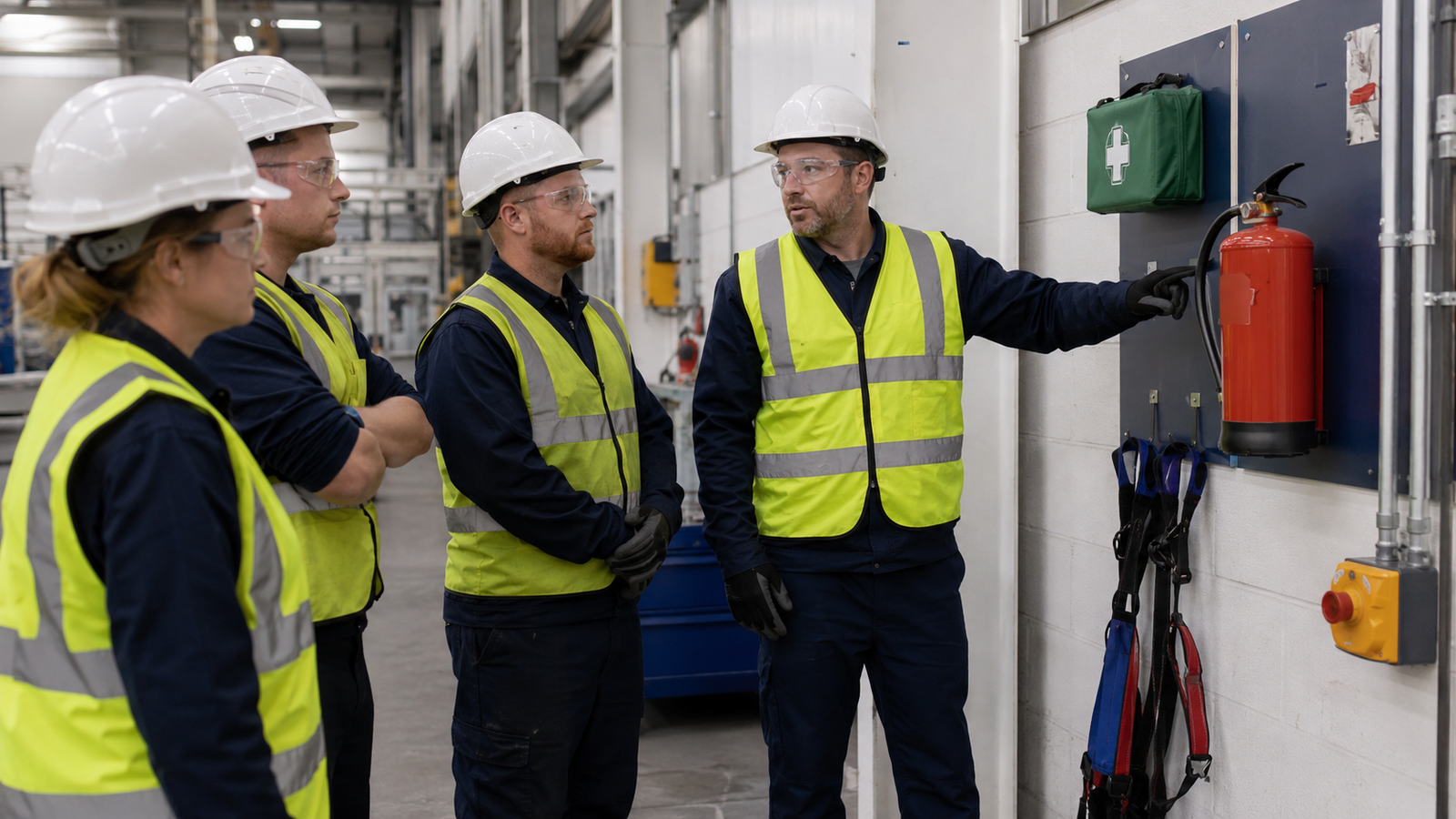
Health and safety English is essential knowledge for anyone working in the UK — it protects you, your colleagues, and is a legal requirement in most workplaces. This guide covers the key phrases you need to report accidents, understand warning signs, and stay safe on the job.
📋 Quick Summary
- Understand common warning signs and safety labels
- Know how to report an accident or near-miss
- Learn the names of Personal Protective Equipment (PPE)
- Always report hazards — even small ones can cause serious injuries
- Health and safety is a legal requirement in most UK workplaces
Health and Safety (H&S) is taken very seriously in the UK. Whether you work in a warehouse, factory, care home, or cleaning job, understanding H&S English is vital for your wellbeing.
This guide covers the most important phrases you need for emergencies, reporting accidents, identifying hazards, and using safety equipment — you can use them immediately on your next shift.
🔑 Key Safety Vocabulary
| Word | Meaning |
|---|---|
| PPE | Personal Protective Equipment — hard hat, safety boots, hi-vis vest, gloves, goggles |
| Near-miss | Something dangerous that almost happened but nobody was hurt |
| Hazard | Anything that could cause harm — a wet floor, a broken machine, loose cables |
| Fire assembly point | The safe place outside where everyone must go during a fire alarm |
| Risk assessment | A check your employer does to identify dangers in the workplace |
| First aider | A trained person who can give basic medical help at work |
| Accident book | The official record where all workplace injuries are written down |
💬 Essential Health & Safety Phrases
“Where is the fire assembly point?”
When to use: Your first day, or when the fire alarm goes off.
Example: “You ask the safety officer: ‘Where is the fire assembly point?'”
Asks for the designated safe location outside the building.
“I need to fill out an accident report.”
When to use: Immediately after you or a colleague have been injured.
Example: “You cut your hand on a box. After getting first aid, you say: ‘I need to fill out an accident report.'”
Formally requests to document an injury in the accident book.
“This area is a trip hazard.”
When to use: You see dangerous cables, boxes, or uneven floors.
Example: “You see cables stretched across a walkway. You warn a coworker: ‘This area is a trip hazard.'”
Identifies a specific location where someone could easily fall.
“I need to report a near-miss.”
When to use: Something dangerous almost happened but nobody was hurt.
Example: “A box fell from the top shelf and missed me. I need to report a near-miss.”
Near-miss reporting is standard practice in the UK to prevent future accidents.
“Can I have some PPE please?”
When to use: You don’t have safety equipment, or it is damaged.
Example: “My safety goggles are cracked. Can I have some PPE please?”
Your employer should provide PPE at no cost to you.
“Is it safe to lift this alone?”
When to use: A box or item looks too heavy for one person.
Example: “This box says 30kg. Is it safe to lift this alone, or do I need help?”
Shows you take manual handling seriously — supervisors respect this.
“Where is the first aid kit?”
When to use: You or a colleague needs basic medical treatment.
Example: “I have a small cut. Where is the first aid kit?”
Most UK workplaces should have suitable first aid equipment available — ask on your first day so you know where it is.
“I do not feel safe doing this.”
When to use: You are asked to do something that feels dangerous.
Example: “The ladder looks broken. I do not feel safe doing this. Can we find another way?”
In the UK, workers generally have the right to raise safety concerns — this phrase does it politely.
🏭 Real Workplace Scenario
Situation: Reporting a near-miss incident to your manager.
You: “Hi, I need to report a near-miss.”
Manager: “Are you okay? What happened?”
You: “Yes, I’m fine. A box fell from the top shelf, but it missed me.”
Manager: “Thank you for reporting it. Let’s fill out the form together.”
You: “Sure. I think the boxes on that shelf need to be stacked more carefully.”
💡 Why this works: Reporting near-misses is standard practice in the UK. The worker explains what happened clearly, confirms they are not injured, and even suggests how to prevent it happening again.
⚠️ Common Mistakes to Avoid
✗ Wrong
“I hurt.”
✓ Correct
“I have injured my hand and need first aid.”
✗ Wrong
Not reporting a near-miss because “nothing happened”
✓ Correct
Always report near-misses: “I need to report a near-miss.”
✗ Wrong
Working without PPE because nobody reminded you
✓ Correct
Ask for PPE if you don’t have it: “Can I have some PPE please?”
✗ Wrong
Lifting heavy items alone to save time
✓ Correct
Ask first: “Is it safe to lift this alone, or do I need help?”
👩💼 Expert Note
In the UK, your employer is generally expected to provide a safe workplace. Workers typically have the right to raise safety concerns and ask for PPE without fear of punishment. Start by learning the safety phrases in this guide — clear communication about health and safety shows your manager that you are a responsible worker.
Ready to improve your workplace English?
Explore more free guides or use our free English tools to practise before your next shift.
❓ Frequently Asked Questions
🧠 Quick Quiz — Test Yourself!
Q1: What does PPE stand for?
Q2: A box nearly fell on you but missed. What should you do?
Q3: You see loose cables across a walkway. What should you say?